If you’re buying a business, applying for financing, or simply trying to gain a clearer understanding of your company’s financial position, you may have come across the term “Compilation Engagement.” While it is one of the most common financial statement services provided to small and medium-sized businesses, many business owners are unsure of what it actually means—and, more importantly, what it does and does not provide.
What Is a Compilation Engagement?
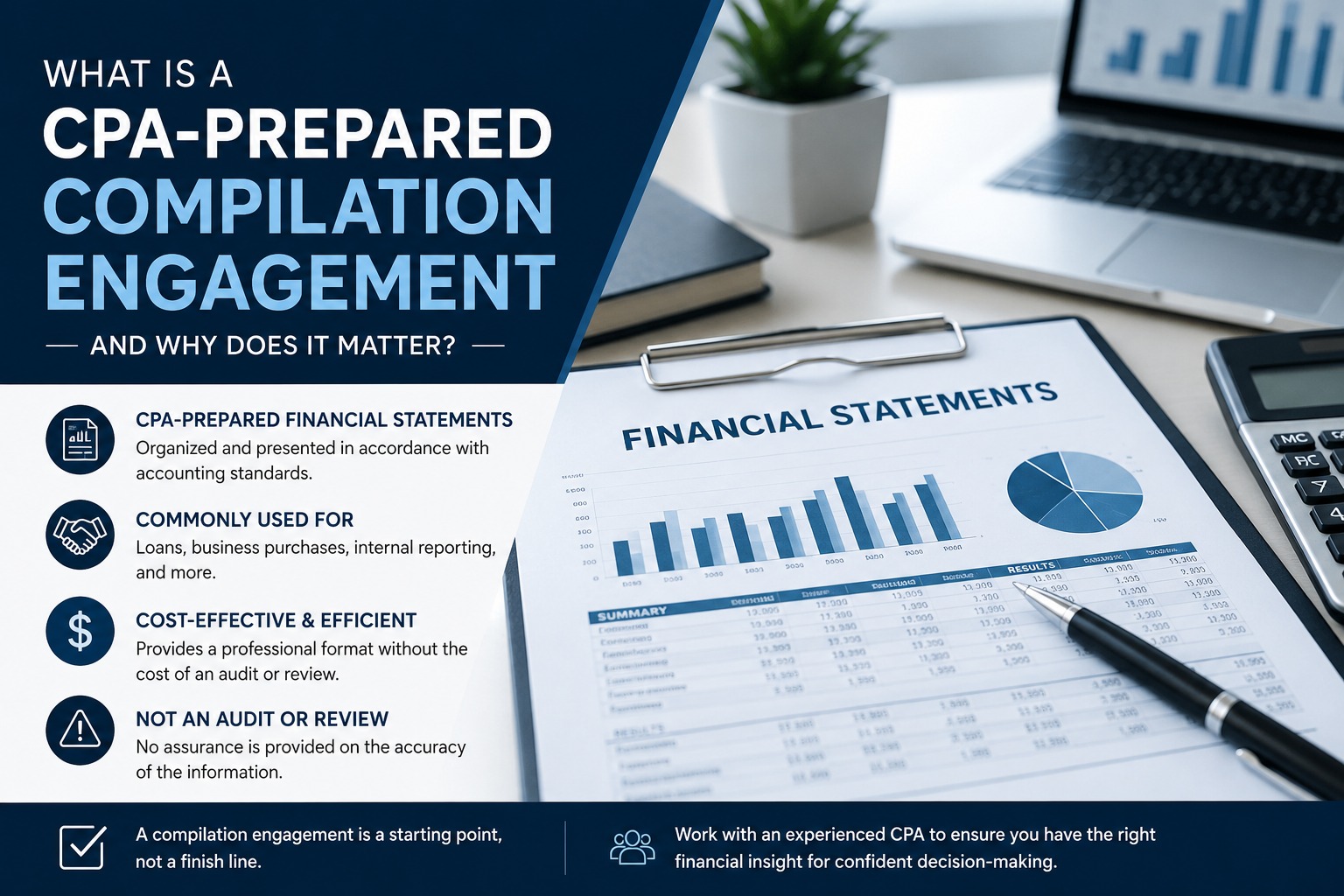
A Compilation Engagement is the most basic level of financial statement service that a Chartered Professional Accountant (CPA) can provide.
Under a compilation engagement, a CPA takes the financial information supplied by management and organizes it into professionally prepared financial statements. These statements are prepared in accordance with applicable accounting standards and are accompanied by a Compilation Engagement Report.
The CPA’s role is to compile and present the information in a clear and structured format. However, the CPA does not verify the accuracy or completeness of the information provided.
What a Compilation Engagement is not
One of the most important aspects of understanding a compilation engagement is recognizing its limitations.
A compilation engagement is not an audit and not a review engagement.
1. It is not an Audit
During an audit, a CPA performs extensive testing and verification procedures to obtain reasonable assurance that the financial statements are free of material misstatement. A compilation engagement does not involve any such testing.
2. It is not a Review Engagement
A review engagement involves analytical procedures and inquiries designed to provide limited assurance on the financial statements. These procedures are not performed in a compilation engagement.
3. It does not provide Assurance
A compilation engagement simply presents financial information supplied by management in a formal financial statement format. No opinion or assurance is expressed on the accuracy of the numbers.
When is a Compilation Engagement used?
Compilation engagements are often the most cost-effective option when assurance is not required. Common situations include:
1. Small Business Financial Reporting
Business owners often use compiled financial statements to better understand their operations, monitor performance, and support internal decision-making.
2. Early-Stage Acquisition Due Diligence
Individuals considering the purchase of a business may receive compilation financial statements as an initial overview of the company’s financial history.
3. Loan and Financing Applications
Some lenders require CPA-prepared financial statements but do not require the higher level of assurance associated with a review or audit engagement.
4. Business Sales and Succession Planning
Business owners preparing to sell their company often provide compiled financial statements to prospective buyers as a starting point for discussions.
5. Professional Practices
Dental, medical, legal, and other professional practices frequently use compilation engagements when preparing financial information for buyers, lenders, or stakeholders.
Why Understanding the Limitations Matters
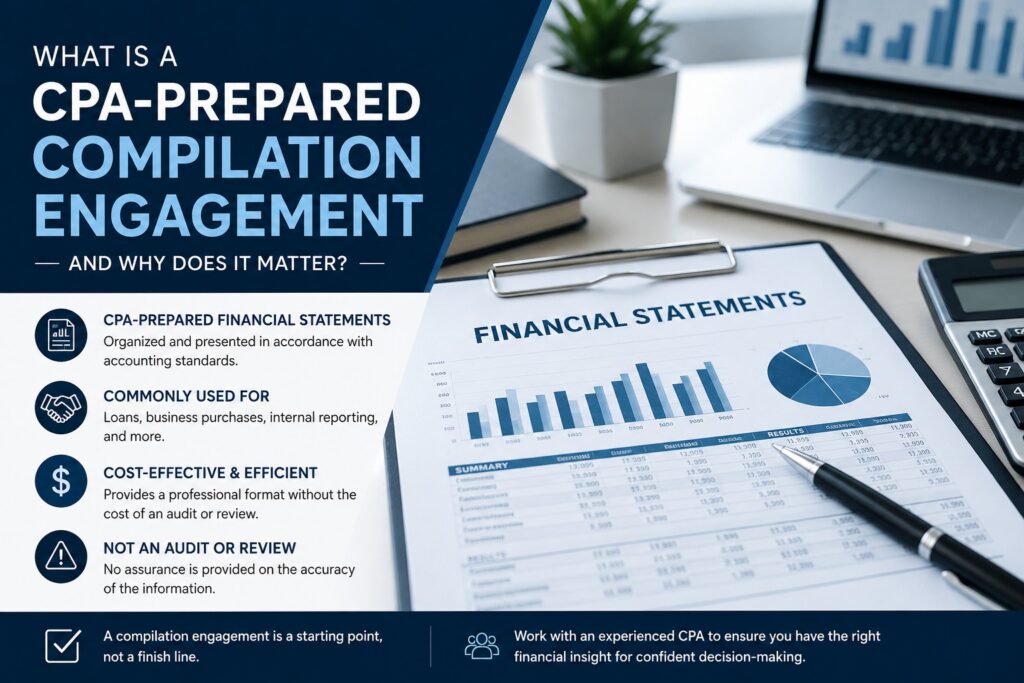
Because a compilation engagement provides no assurance, it is important not to rely on it as the sole basis for major business decisions.
For example, if you are purchasing a business, a compilation engagement alone does not constitute proper due diligence. A deeper financial analysis may be necessary to evaluate:
- Revenue trends and sustainability
- Profitability and cash flow performance
- Industry benchmarking
- Customer concentration risks
- Working capital requirements
- Potential financial red flags
An experienced CPA with transaction advisory expertise can help uncover issues that may not be visible from compiled financial statements alone.
The Bottom Line
A CPA-prepared compilation engagement is an excellent tool for organizing and presenting financial information in a professional format. It can be useful for business owners, lenders, buyers, and sellers who need structured financial statements without the additional cost of a review or audit.
However, it is important to understand that a compilation engagement is a starting point—not a finish line. When significant financial decisions are involved, additional analysis and due diligence may be required to fully understand the financial health of a business.
If you’re unsure whether a compilation engagement, review engagement, or audit is the right choice for your situation, speaking with a CPA can help ensure you have the right level of financial reporting and assurance for your needs.